
Professional Home Remodeling in Nesconset, NY
Meigel Home Improvements brings BBB A+ rated, family-owned craftsmanship to every remodeling project in Nesconset, combining decades of local experience with reliable, professional service homeowners trust.
Expert Home Remodeling in Nesconset, NY
Meigel Home Improvements brings BBB A+ rated, family-owned remodeling expertise to Nesconset homeowners who value quality craftsmanship and dependable service.
We’ve been helping homeowners throughout Nesconset bring their kitchens and bathrooms to life for years, and we understand what it takes to get the job done right. At Meigel Home Improvements, we treat every project with the same care and attention we’d give our own homes, whether you’re in the quiet streets near Gibbs Pond or closer to Smithtown Boulevard. Our team works closely with you from design through completion, making sure the process is straightforward and the results reflect your vision. We’re a licensed, family-owned company that believes good remodeling comes from listening first and building with skill. If you’re ready to start your kitchen or bathroom project, give us a call at (631) 430-5995 for a free estimate.
Our Services in Nesconset
Remodeling Homes in Nesconset
We’ve worked in Nesconset for years, and we know the homes here well. From the tree-lined streets around Gibbs Pond to the established neighborhoods near Smithtown Landing Country Club and the family-friendly areas along Hawkins Avenue, this community is defined by its solid housing stock and strong sense of place. Most homes date from the 1960s through the 1980s, with plenty of ranch homes, split-levels, and colonials that still have their original kitchens and bathrooms.
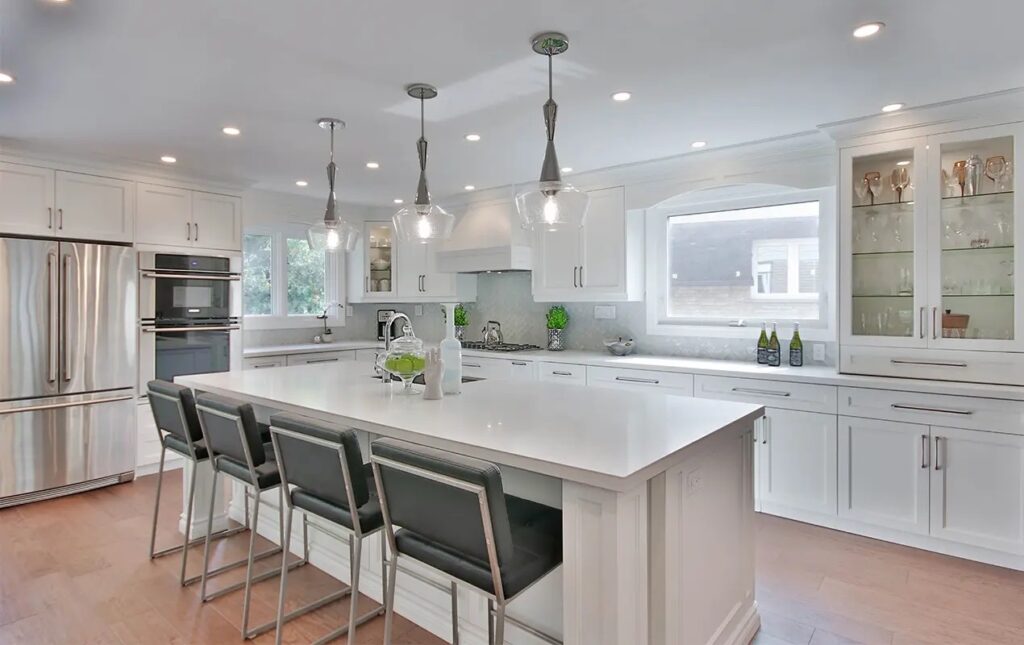
These homes were built to last, but decades-old layouts and fixtures no longer serve how families live today. Kitchens that once felt spacious now lack the counter space, storage, and functionality modern cooking demands. Bathrooms with outdated tile, poor lighting, and cramped layouts make daily routines harder than they should be. We see it constantly in Nesconset homes, and we know how to fix it.
Remodeling your kitchen or bathroom does more than improve your day-to-day comfort. It protects your investment in a community where homes hold their value and buyers expect updated spaces. We bring decades of experience, careful planning, and skilled craftsmanship to every project, and we treat your home with the respect it deserves.
What does a kitchen remodel cost in Nesconset, NY?
Kitchen remodeling costs in Nesconset typically range from $25,000 to $75,000 depending on the scope of work, materials selected, and the size of your space. A minor refresh with new cabinets, countertops, and appliances usually starts around $25,000, while a full-scale renovation with custom cabinetry, high-end finishes, and layout changes can exceed $60,000. We provide detailed estimates for every project and work with homeowners throughout Suffolk County to find solutions that fit their budget and vision.
How long does a bathroom remodel take in Nesconset?
Most bathroom remodels in Nesconset take between two to four weeks from start to finish, though the timeline depends on the project’s complexity and whether structural changes are involved. A straightforward update with new fixtures, tile, and vanity can often be completed in two weeks, while a full renovation with plumbing relocation or expanded square footage may require closer to four weeks or slightly longer. We establish a clear timeline during our initial consultation and keep homeowners informed throughout the entire process.
Do I need permits for kitchen or bathroom remodeling in New York?
Permits are required in New York for most kitchen and bathroom remodels that involve electrical work, plumbing changes, or structural modifications. The Town of Smithtown, which governs Nesconset, requires permits for projects that go beyond simple cosmetic updates like painting or replacing fixtures. We handle all permit applications and inspections as part of our remodeling services, ensuring your project meets local building codes and passes all required inspections in Suffolk County.
How can I verify a contractor is licensed in Suffolk County?
You can verify a contractor’s license in Suffolk County by checking with the New York State Department of Labor or requesting their license number and insurance documentation directly. All legitimate home improvement contractors in New York must be registered with the state and carry proper liability insurance and workers’ compensation coverage. We provide our credentials upfront and encourage Nesconset homeowners to verify any contractor they consider hiring, as working with properly licensed professionals protects you from liability and ensures quality workmanship.

Project Gallery



Why Choose US
Why Work With Meigel Home Improvements?
Expert Craftsmanship You Can Trust
Choosing the right remodeling contractor is essential for a successful project, and Meigel Home Improvements is proud to be a trusted name in the Hauppauge community. Our experienced team brings a keen eye for detail, ensuring that every project is completed to the highest standard. We combine timeless design with modern functionality to create spaces that truly enhance your home and lifestyle.
Reliable, Transparent, and Customer-Focused
When you work with Meigel Home Improvements, you can expect honesty, integrity, and clear communication every step of the way. We pride ourselves on delivering exceptional service and making the remodeling process as seamless as possible for our clients. From the initial consultation to the final walkthrough, we treat your home as if it were our own, ensuring you feel confident and comfortable throughout the project.
Check Out Our Recent Blogs
Occupying approximately 5.5 square miles in central Suffolk County within the Town of Smithtown roughly 50 miles east of Manhattan, Nesconset represents something distinctly unremarkable in Long Island’s suburban landscape—a hamlet of approximately 13,000-14,000 residents whose character as middle-class residential enclave developed through post-war suburban expansion creating subdivisions on former farmland, whose identity derives primarily from school district affiliation (Smithtown Central School District) rather than civic institutions or downtown focal point, whose location along the Nesconset-Port Jefferson corridor (Route 347) creates automobile-dependent commercial strip development indistinguishable from suburban patterns nationwide, and whose particular appeal rests precisely in ordinariness—neither exclusive nor struggling, neither culturally distinctive nor economically distressed, neither extraordinarily affluent nor working-class, but rather occupying the comfortable middle ground where families purchase modest homes, send children to decent public schools, commute to employment throughout Long Island or occasionally Manhattan, and experience the suburban normalcy that post-war development patterns promised to deliver and largely achieved for populations able to afford entry into middle-class Long Island existence.
The name “Nesconset” derives from a Native American term reportedly meaning “at the second crossing” or referencing geographic features, though precise etymology remains uncertain—typical for place names with indigenous origins subjected to European interpretation and linguistic transformation. The area remained agricultural through the 19th century and early 20th century, with farming operations, estate properties, and rural character persisting until post-World War II suburban development transformed the landscape.
The explosive Long Island suburban growth following World War II—driven by returning veterans utilizing VA loans, highway construction enabling commuter access to Manhattan, and families seeking homeownership and yard space that urban apartments couldn’t provide—reached Nesconset during the 1950s-1960s. Developers purchased farmland for residential subdivisions creating the ranch and cape-style homes on quarter-acre to half-acre lots that would house the baby boom generation and define Nesconset’s physical and demographic character.
The construction of Long Island Expressway (I-495) and Northern State Parkway created transportation infrastructure enabling reasonable commutes to Manhattan employment centers, though most Nesconset residents work locally throughout Suffolk County or in Nassau County rather than enduring 75-90 minute commutes to New York City. The development of nearby employment centers—Hauppauge’s corporate office parks, medical facilities, retail concentrations—provided local job opportunities reducing commuting necessity.
Nesconset’s status as unincorporated hamlet within Smithtown township means governance operates through town government rather than local village control, creating limited capacity for comprehensive planning, design review, or development regulation beyond town-wide policies. This governance structure contributed to the strip commercial development along Route 347, generic subdivision patterns, and absence of downtown focal point that incorporated villages avoided through stricter local control.
Contemporary Nesconset presents the ordinariness that defines successful middle-class suburbia—functional schools producing adequate outcomes, safe neighborhoods supporting family life, convenient shopping and services along commercial corridors, reasonable housing costs by Long Island standards—while confronting the questions about whether such comfortable normalcy represents sustainable achievement or temporary condition threatened by property tax escalation, housing cost increases, aging demographics, and the particular challenges facing communities lacking distinctive identity, economic advantages, or civic institutions creating resilience when external pressures mount.
Demographics
Nesconset’s demographic profile reveals predominantly white, middle-class population whose characteristics reflect Long Island suburban development patterns with modest diversity and aging demographics typical of mature suburbs.
The population of approximately 13,000-14,000 residents has remained relatively stable over recent decades, showing minimal growth after the explosive expansion during the 1950s-1970s suburban boom when subdivisions consumed available farmland. Current stagnation reflects build-out conditions where limited remaining developable land prevents significant expansion.
Population density approaches 2,360-2,545 persons per square mile—moderate suburban density reflecting single-family home subdivisions on quarter-acre to half-acre lots characteristic of mid-20th century Long Island development, with commercial areas along Route 347 and preserved open space moderating overall density.
Racial and ethnic composition shows substantial white majority with limited diversity. White residents comprise approximately 88-91% of the population—overwhelming predominance typical of Long Island suburbs where economic barriers and self-selection create relatively homogeneous communities. Asian residents represent approximately 5-7%—modest presence concentrated among professional populations. Hispanic or Latino residents comprise approximately 3-4%, and Black or African American residents approximately 1-2%, demonstrating minimal diversity characteristic of middle-class Suffolk County suburbs.
This demographic homogeneity reflects both historical development patterns when Long Island remained overwhelmingly white and contemporary economic filtering where housing costs and community character attract particular populations while creating barriers for others. The modest diversity increasing gradually suggests some demographic change, though nothing approaching the transformation experienced by communities like Central Islip or Brentwood.
Age distribution shows mature suburban profile with aging population. Median age approaches 45-48 years—substantially above national averages (38 years) and reflecting the demographic pattern where families who purchased homes during the 1960s-1980s suburban boom have aged in place while younger families face affordability challenges limiting new family formation. The population includes substantial empty-nester and retiree presence alongside established middle-aged families, with relatively fewer young families with school-age children than during Nesconset’s growth period.
Household income statistics reveal solid middle-class character. Median household income approaches $100,000-110,000 annually—substantially above national median ($75,000) though typical for Long Island suburbs where high costs of living require elevated incomes for middle-class existence. Income distribution shows concentration in $75,000-140,000 range—the middle-class spectrum enabling comfortable suburban living without exceptional wealth.
Occupations span varied fields—healthcare (hospitals and medical facilities throughout Suffolk County employ thousands), education, business services, trades, retail, public sector—with residents employed throughout Long Island rather than concentrated in particular industries or locations. The employment diversity creates economic stability less vulnerable to single-industry decline.
Poverty rates remain low—approximately 3-5%—indicating overwhelming majority of residents experience economic security, though housing costs create financial stress even for middle-class families earning solid incomes struggling with property taxes and living expenses.
Housing costs demonstrate Nesconset’s positioning as affordable middle-class option within Long Island context. Single-family homes typically range from $400,000-525,000 for modest ranch or cape properties to $575,000-750,000 for larger colonials or renovated homes. These prices—while astronomical by national standards—position Nesconset as accessible to middle-class families compared to Nassau County suburbs ($600,000-1 million+) or North Shore villages ($800,000-2 million+).
Property taxes typically range from $10,000-16,000 annually for standard properties—creating ongoing financial burden consuming substantial portions of middle-class income. The taxes fund Smithtown town services, school districts, special districts, and Suffolk County operations.
Educational attainment shows middle-class patterns. Bachelor’s degree attainment approaches 38-42%—above national averages (33%) though below most affluent Long Island communities, reflecting mix of professional populations and families where college attendance remains less universal. High school graduation rates exceed 92%, indicating virtually universal secondary completion.
Education
Education in Nesconset operates through Smithtown Central School District, serving Nesconset alongside other Smithtown hamlets. The district operates elementary schools (Nesconset Elementary serving the hamlet), middle schools, and high schools (Smithtown High School East and West), with Nesconset students typically attending Smithtown High School East.
Student demographics from Nesconset feeders show approximately 85-88% white enrollment, 6-8% Asian, 3-5% Hispanic, 2-3% Black—modest diversity reflecting the hamlet’s composition. Free and reduced-price lunch eligibility approaches 6-9%, indicating predominantly middle-class student body with minimal poverty concentration.
Academic performance shows solid middle-class results. SAT scores average approximately 1180-1210—above national averages (1050) and respectable by Long Island standards, though falling well below elite districts like Great Neck or Jericho (1300-1450) and even affluent Syosset (1350-1400). Graduation rates approach 96-97%—strong completion showing virtually all students finish high school.
Per-pupil spending approximates $26,000-28,000 annually—typical for Long Island and reflecting both the high costs and comprehensive programming that property tax funding enables. The spending supports adequate operations, competitive teacher salaries by Long Island standards, established facilities, and programming that resource-constrained districts cannot provide.
The district offers comprehensive programming including Advanced Placement courses (though not the extensive offerings of wealthiest districts), competitive athletics (Long Island high school sports, particularly football and lacrosse, generate intense community engagement), and college preparatory curriculum. The schools serve genuinely middle-class populations including economic diversity, creating environments where most students receive solid preparation without the extreme achievement pressure or resource abundance characterizing wealthiest districts.
College attendance among graduates likely approaches 78-82%, with students attending SUNY schools (Stony Brook, Binghamton, Albany, Buffalo), private colleges (Hofstra, Adelphi, regional institutions), community colleges (Suffolk County Community College), and varied four-year universities. The attendance rates reflect solid academic preparation and middle-class family expectations that college represents pathway to economic opportunity, though not the near-universal elite university attendance characterizing wealthiest Long Island suburbs.
The schools benefit from middle-class demographics providing adequate family resources, parental engagement, and stability enabling consistent attendance, though without the extraordinary advantages—extensive private tutoring, test preparation, enrichment programs, parental resources enabling comprehensive supplementation—that affluent districts access routinely.
Tourism
Tourism in Nesconset operates at zero—the hamlet possesses no attractions, destinations, cultural institutions, historic sites, or features generating outside visitation. The residential subdivisions, strip commercial development along Route 347, and absence of distinctive character create community functioning purely for residents without any visitor appeal.
Caleb Smith State Park Preserve borders Nesconset providing trails and natural areas, though the park serves primarily local Long Island residents for recreation rather than tourists traveling specifically to visit. The park offers modest hiking, nature observation, and environmental education without the scale or distinctiveness creating significant tourism draw.
For Nesconset’s approximately 13,000-14,000 residents, the hamlet provides middle-class Long Island suburban lifestyle—decent schools enabling children’s educational opportunities without the pressure cooker intensity of elite districts, safe neighborhoods supporting family life, convenient shopping and services along Route 347, proximity to employment throughout central Long Island, reasonable (though still lengthy) commutes to Manhattan via LIRR from nearby stations, though confronting challenges of high property taxes consuming significant income portions ($10,000-16,000 annually creating ongoing burden), housing costs creating affordability stress even at middle-class incomes, automobile dependence where all activities require driving, aging demographics as younger families struggle to afford entry while longtime residents age in place, lack of distinctive identity or civic institutions creating community beyond school district affiliation, and fundamental questions about whether Long Island’s suburban model built on affordable middle-class homeownership remains sustainable when property taxes, housing costs, and overall expenses increasingly strain the middle-class populations for whom suburbs were originally developed, making Nesconset both success story demonstrating functional middle-class suburbia and cautionary tale about suburban sustainability absent the extraordinary affluence that enables some Long Island communities to thrive while ordinary middle-class hamlets struggle with mounting costs threatening the comfortable normalcy that represents both Nesconset’s appeal and its vulnerability.
- Bohemia NY
- Brentwood NY
- Centereach NY
- Center Islip NY
- Commack NY
- Deer Park NY
- Dix Hills NY
- East Islip NY
- East Meadow NY
- East Northport NY
- East Norwich NY
- East Patchogue NY
- East Setauket NY
- Farmingdale NY
- Farmingville NY
- Freeport NY
- Glen Head NY
- Great River NY
- Greenlawn NY
- Hauppauge NY
- Hicksville NY
- Holbrook NY
- Holtsville NY
- Huntington NY
- Huntington Station NY
- Islandia NY
- Islip NY
- Islip Terrace NY
- Jericho NY
- Kings Park NY
- Lake Grove NY
- Levittown NY
- Lindenhurst NY
- Massapequa NY
- Massapequa Park NY
- Mastic Beach NY
- Mastic NY
- Medford NY
- Melville NY
- Merrick NY
- Mid Island NY
- Middle Island NY
- Mill Neck NY
- Miller Place NY
- Mount Sinai NY
- Nesconset NY
- North Babylon NY
- North Bellmore NY
- Northport NY
- Oakdale NY
- Ocean Beach NY
- Old Bethpage NY
- Oyster Bay NY
- Patchogue NY
- Plainview NY
- Point Lookout NY
- Port Jefferson NY
- Port Jefferson Station NY
- Rocky Point NY
- Ronkonkoma NY
- Roosevelt NY
- Saint James NY
- Sayville NY
- Seaford NY
- Selden NY
- Shirley NY
- Shoreham NY
- Smithtown NY
- Sound Beach NY
- Stony Brook NY
- Syosset NY
- Uniondale NY
- Wantagh NY
- West Babylon NY
- West Islip NY
- West Sayville NY
- Westbury NY
- Woodbury NY
- Wyandanch NY
- Yaphank NY