
Expert Home Remodeling in Port Jefferson Station, NY
Meigel Home Improvements brings BBB A+ rated craftsmanship and family-owned reliability to every remodeling project we complete in Port Jefferson Station.
Reliable Home Remodeling in Port Jefferson Station, NY
Meigel Home Improvements brings BBB A+ rated craftsmanship and three generations of family-owned expertise to every remodeling project in Port Jefferson Station.
We’ve been helping homeowners throughout Port Jefferson Station transform their kitchens and bathrooms for years, and we understand what it takes to get the job done right. At Meigel Home Improvements, we bring careful planning, skilled craftsmanship, and respectful service to every project, whether you’re updating a home near Terryville Road or renovating in the neighborhoods around Bicycle Path. Our team works closely with you from the first conversation through final walkthrough, making sure your remodeling experience reflects the quality and attention to detail your home deserves. We’re a licensed, family-owned company that treats your property with the same care we’d bring to our own. If you’re ready to discuss your kitchen or bathroom project, call us at (631) 430-5995 for a free estimate.
What We Offer in Port Jefferson Station
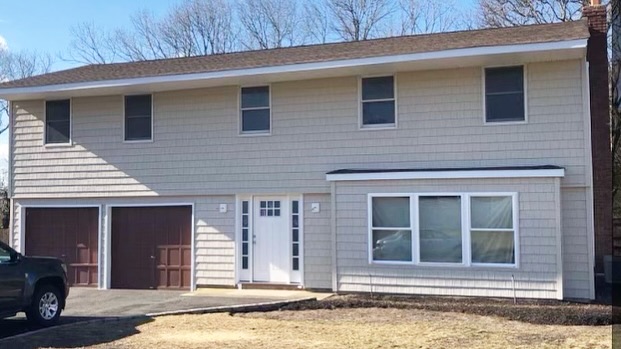
Remodeling Homes in Port Jefferson Station
Port Jefferson Station is home to established neighborhoods like Terryville and the tree-lined streets around Edgewood Avenue, where you’ll find classic post-war housing that defines this community. The housing stock here consists largely of ranch homes, split-levels, and Cape Cods built during the 1950s and 1960s, many of which still retain their original kitchens and bathrooms. We’ve worked extensively throughout Port Jefferson Station and understand how these homes were built and what they need to function well for today’s families.
The original layouts in these homes often feature small, compartmentalized kitchens with limited counter space and outdated bathrooms with cramped vanities and old tile work. Remodeling these spaces delivers real value because buyers in this area actively seek updated homes that don’t require immediate work. We’ve seen how a thoughtfully designed kitchen or bathroom renovation can transform how families use these homes while significantly improving resale appeal. The bones of these mid-century homes are solid, which makes them excellent candidates for updates that respect the original structure while bringing modern functionality. Our team knows the permitting process and building requirements specific to this area, and we bring that local knowledge to every project we complete in Port Jefferson Station.
“`html
What does a kitchen remodel typically cost in Port Jefferson Station?
Kitchen remodeling costs in Port Jefferson Station generally range from $25,000 to $75,000 depending on the size of your kitchen and the scope of work involved. A basic refresh with new cabinets, countertops, and appliances typically starts around $25,000 to $40,000, while a full renovation with custom cabinetry, high-end materials, and layout changes can reach $60,000 to $75,000 or more. We provide detailed estimates after visiting your home to understand your specific needs and goals for the space.
How long does a bathroom remodel take in Port Jefferson Station?
Most bathroom remodels in Port Jefferson Station take between two to four weeks from start to finish, depending on the complexity of the project. A straightforward update with new fixtures, tile, and vanity usually takes about two to three weeks, while a complete renovation involving plumbing relocation or structural changes may extend to four weeks or slightly longer. We work efficiently to minimize disruption to your daily routine while ensuring quality craftsmanship throughout the process.
Are permits required for kitchen and bathroom remodeling in Port Jefferson Station?
Permits are required in Port Jefferson Station for most kitchen and bathroom remodels that involve plumbing, electrical work, or structural modifications. The Town of Brookhaven, which governs Port Jefferson Station, requires homeowners to obtain building permits before beginning work that affects these systems. We handle the permit application process with the town as part of our service, ensuring all work meets local building codes and passes required inspections.
How can I verify a contractor is properly licensed in Suffolk County?
You can verify a contractor’s license in Suffolk County by checking with the Suffolk County Department of Consumer Affairs, which maintains records of registered home improvement contractors. Every legitimate contractor should provide you with their Suffolk County Home Improvement Contractor license number, and you can confirm their standing by calling the department or visiting their office in Hauppauge. We’re licensed and insured in Suffolk County, and we’re always happy to provide our credentials and references from other Port Jefferson Station homeowners we’ve worked with.
“`
Surrounding Communities
Project Gallery


Why Work With Meigel Home Improvements?
Expert Craftsmanship You Can Trust
Choosing the right remodeling contractor is essential for a successful project, and Meigel Home Improvements is proud to be a trusted name in the Hauppauge community. Our experienced team brings a keen eye for detail, ensuring that every project is completed to the highest standard. We combine timeless design with modern functionality to create spaces that truly enhance your home and lifestyle.
Reliable, Transparent, and Customer-Focused
When you work with Meigel Home Improvements, you can expect honesty, integrity, and clear communication every step of the way. We pride ourselves on delivering exceptional service and making the remodeling process as seamless as possible for our clients. From the initial consultation to the final walkthrough, we treat your home as if it were our own, ensuring you feel confident and comfortable throughout the project.
Check Out Our Recent Blogs

Occupying approximately 5.8 square miles in northwestern Suffolk County within the Town of Brookhaven roughly 60 miles east of Manhattan, Port Jefferson Station represents something distinctly subordinate in Long Island’s suburban landscape—a hamlet of approximately 7,800-8,500 residents whose identity derives almost entirely from geographic proximity to incorporated Port Jefferson village while lacking the waterfront access, historic downtown, village governance, and cultural character that make Port Jefferson genuinely distinctive, whose working-class to lower-middle-class character reflects the economic filtering that property values create when desirable communities generate premium prices pushing working-class populations into adjacent unincorporated areas offering proximity benefits without corresponding amenities, whose commercial development along Route 112 and Nesconset Highway creates strip commercial environment serving functional needs without aesthetic distinction, and whose particular position as the Station to Port Jefferson’s Village creates permanent subordinate identity where residents inhabit the affordable shadow of desirable community without accessing the quality of life that desirability reflects, making Port Jefferson Station the quintessential Long Island hamlet existing in the orbit of more successful neighbor while developing neither independent identity nor full access to adjacent community’s advantages.
The name “Port Jefferson Station” references the Long Island Rail Road station serving the Port Jefferson branch terminus—the railroad infrastructure defining the community’s functional identity as transportation node rather than destination. The “Station” suffix appearing throughout Long Island (Mineola Station, Farmingdale, Deer Park) consistently indicates communities that developed around railroad infrastructure serving adjacent more established communities, creating the subordinate identity that the designation encodes.
The area developed primarily through post-war suburban expansion as families seeking affordable alternatives to increasingly expensive Port Jefferson proper established residence in the adjacent unincorporated hamlet. The LIRR station—providing the same rail access as Port Jefferson village but without the village’s waterfront, downtown, and cultural character—created transportation convenience enabling residential development serving working-class and lower-middle-class populations employed throughout central Suffolk County.
Commercial development along Route 112 created the strip commercial corridor serving neighborhood needs—supermarkets, pharmacies, auto-related businesses, chain restaurants, and service establishments providing functional access without the distinctive locally-owned character that Port Jefferson’s downtown maintains. This commercial character reflects working-class consumer patterns where accessibility and price matter more than experience or authenticity.
The presence of Mather Hospital—significant healthcare facility within the hamlet—creates employment anchor providing medical jobs for nurses, technicians, administrators, and support staff, supplementing the healthcare employment that Stony Brook University Hospital generates throughout the region. The hospital’s presence as institutional employer creates economic stability while generating healthcare-oriented professional populations choosing Port Jefferson Station for convenient residence near employment.
Contemporary Port Jefferson Station presents the working-class reality adjacent to desirable community—affordable housing enabling residence near amenities that property values prevent direct access to, adequate schools providing educational foundation without the excellence driving premium property values, commercial strips serving functional needs without creating destination appeal, and the particular challenge of developing community identity when geographic designation permanently encodes subordinate relationship to more successful neighbor.
Demographics
Port Jefferson Station’s demographic profile reveals working-class to lower-middle-class population with meaningful diversity reflecting the economic accessibility that modest housing costs create.
The population of approximately 7,800-8,500 residents has remained relatively stable over recent decades with modest demographic change through immigration and household turnover. Population density approaches 1,345-1,465 persons per square mile—relatively low for Suffolk County reflecting the mix of residential neighborhoods, commercial corridors, and institutional land uses.
Racial and ethnic composition shows white majority with meaningful diversity. White residents comprise approximately 70-74% of the population—substantial majority but lower than many North Shore communities. Hispanic or Latino residents represent approximately 16-20%—meaningful presence reflecting immigration attracted by affordable housing and service sector employment. Asian residents comprise approximately 5-7%—modest presence influenced by healthcare employment proximity. Black or African American residents approximately 4-5%, demonstrating genuine diversity unusual for this portion of the North Shore.
Age distribution shows relatively balanced suburban profile. Median age approaches 38-42 years—near national averages reflecting working-age family demographics alongside some retirees and younger households.
Household income statistics reveal working-class to lower-middle-class character. Median household income approaches $72,000-82,000 annually—below Long Island averages ($100,000-115,000) and reflecting concentration of healthcare support, service sector, retail, construction, and trades employment. Many households require dual incomes maintaining suburban residence despite Port Jefferson Station’s comparative affordability.
Poverty rates reach 10-13%—above Long Island averages indicating meaningful economic distress concentrated particularly among Hispanic immigrant families and service sector workers whose wages prove insufficient for regional cost of living. Housing costs demonstrate Port Jefferson Station’s comparative affordability. Single-family homes typically range from $290,000-390,000 for modest properties to $430,000-550,000 for larger houses—substantially below neighboring Port Jefferson village ($450,000-1.5 million) and creating accessibility for working-class families.
Rental housing serves diverse populations at $1,100-1,600 monthly—somewhat more affordable than Port Jefferson proper attracting students, young professionals, and working-class households seeking proximity to village amenities at lower cost. Property taxes typically range from $8,500-13,000 annually. Educational attainment shows working-class patterns with bachelor’s degree attainment approaching 28-33%—near national averages but below Long Island norms.
Education
Education in Port Jefferson Station operates primarily through Comsewogue Union Free School District, serving the hamlet alongside portions of surrounding communities. The district operates elementary schools, Comsewogue Middle School, and Comsewogue High School, enrolling approximately 2,800-3,200 students.
Student demographics show approximately 62-66% white enrollment, 24-27% Hispanic enrollment, 5-6% Black enrollment, 4-5% Asian enrollment—substantial diversity reflecting working-class community composition. Free and reduced-price lunch eligibility approaches 40-45%—substantial percentage indicating significant economic diversity with many students experiencing disadvantage creating educational challenges.
Academic performance shows below-average results by Long Island standards. SAT scores average approximately 1000-1040—below national averages (1050) and substantially below neighboring Port Jefferson village district (1180-1220), demonstrating how municipal boundaries and economic filtering create dramatically different educational outcomes for students living miles apart. Graduation rates approach 87-90%—below Long Island averages indicating meaningful completion challenges.
Per-pupil spending approximates $21,000-23,000 annually—below Long Island averages reflecting the modest property tax base from working-class housing values. The spending enables basic operations without comprehensive AP programming, extensive support services, or resources characterizing well-funded districts.
English Language Learner populations approach 18-22%—substantial percentages requiring intensive language instruction consuming significant resources. Teacher turnover reaches 18-24% annually as educators seek positions in less challenging districts, destabilizing instructional continuity and concentrating inexperienced teachers in highest-need classrooms.
The contrast with Port Jefferson village district—serving more affluent populations with stronger academic performance—demonstrates with particular clarity how school district boundaries encode economic inequality, creating dramatically different educational outcomes for students separated by miles but divided by property values determining district assignment. College attendance among graduates likely approaches 58-63%—below Long Island averages, predominantly community college enrollment with limited selective university attendance.
Tourism
Tourism in Port Jefferson Station operates at zero independent of neighboring Port Jefferson village. The hamlet possesses no attractions, cultural institutions, waterfront access, historic character, or distinctive features generating visitation in its own right.
Visitors arriving via LIRR or traveling Route 112 pass through Port Jefferson Station en route to Port Jefferson village, occasionally stopping at commercial establishments without engaging the hamlet as destination. The strip commercial development along Route 112 serves regional populations and pass-through traffic without creating destination appeal.
Mather Hospital generates occasional family visitors and patient traffic without creating tourism activity benefiting surrounding community.
For Port Jefferson Station’s approximately 7,800-8,500 residents, the hamlet provides working-class Long Island suburban existence defined substantially by proximity to more successful neighbor—affordable housing enabling residence near Port Jefferson village’s waterfront and cultural amenities that property values prevent direct access to, LIRR station providing Manhattan commute access (approximately 80-90 minutes to Penn Station), Mather Hospital employment creating healthcare sector jobs, adequate though below-average schools providing educational foundation without the quality that port Jefferson village’s independent district delivers, commercial strips meeting functional needs, and the particular challenge of community identity when geographic designation permanently encodes subordinate relationship to neighboring village, confronting ongoing challenges of property taxes consuming substantial working-class income portions, schools underperforming relative to neighboring district despite geographic proximity, limited governance capacity as unincorporated hamlet preventing local policy responses, demographic tensions navigating cultural change from immigration, commercial strip character lacking pedestrian appeal, and the fundamental reality that communities existing in the affordable shadow of desirable neighbors occupy permanently subordinate position in metropolitan geography—providing essential residential function for working-class populations while receiving neither the amenities that desirability creates nor the recognition that essential metropolitan function deserves, making Port Jefferson Station both cautionary example of how governance boundaries and property values create inequality within single geographic area and necessary component of regional housing ecosystem providing affordable access that exclusivity elsewhere prevents.
- Deer Park NY
- Dix Hills NY
- East Islip NY
- East Meadow NY
- East Northport NY
- East Norwich NY
- East Patchogue NY
- East Setauket NY
- Farmingdale NY
- Farmingville NY
- Freeport NY
- Glen Head NY
- Great River NY
- Greenlawn NY
- Hauppauge NY
- Hicksville NY
- Holbrook NY
- Holtsville NY
- Huntington NY
- Huntington Station NY
- Islandia NY
- Islip NY
- Islip Terrace NY
- Jericho NY
- Kings Park NY
- Lake Grove NY
- Levittown NY
- Lindenhurst NY
- Massapequa NY
- Massapequa Park NY
- Mastic Beach NY
- Mastic NY
- Medford NY
- Melville NY
- Merrick NY
- Mid Island NY
- Middle Island NY
- Mill Neck NY
- Miller Place NY
- Mount Sinai NY
- Nesconset NY
- North Babylon NY
- North Bellmore NY
- Northport NY
- Oakdale NY
- Ocean Beach NY
- Old Bethpage NY
- Oyster Bay NY
- Patchogue NY
- Plainview NY
- Point Lookout NY
- Port Jefferson NY
- Port Jefferson Station NY
- Rocky Point NY
- Ronkonkoma NY
- Roosevelt NY
- Saint James NY
- Sayville NY
- Seaford NY
- Selden NY
- Shirley NY
- Shoreham NY
- Smithtown NY
- Sound Beach NY
- Stony Brook NY
- Syosset NY
- Uniondale NY
- Wantagh NY
- West Babylon NY
- West Islip NY
- West Sayville NY
- Westbury NY
- Woodbury NY
- Wyandanch NY
- Yaphank NY